


Document to HTML Conversion
Seamless Conversion from Documents to HTML
Modern websites are expected to be fast, flexible, accessible, and easy to maintain. Unfortunately, many organizations are still relying on static documents like PDFs, Word files, and spreadsheets to deliver critical information. While these formats may be convenient to create or distribute internally, they are not built for today’s web. They do not scale well on mobile devices, are difficult for search engines to index properly, and often create accessibility challenges for users relying on assistive technologies.
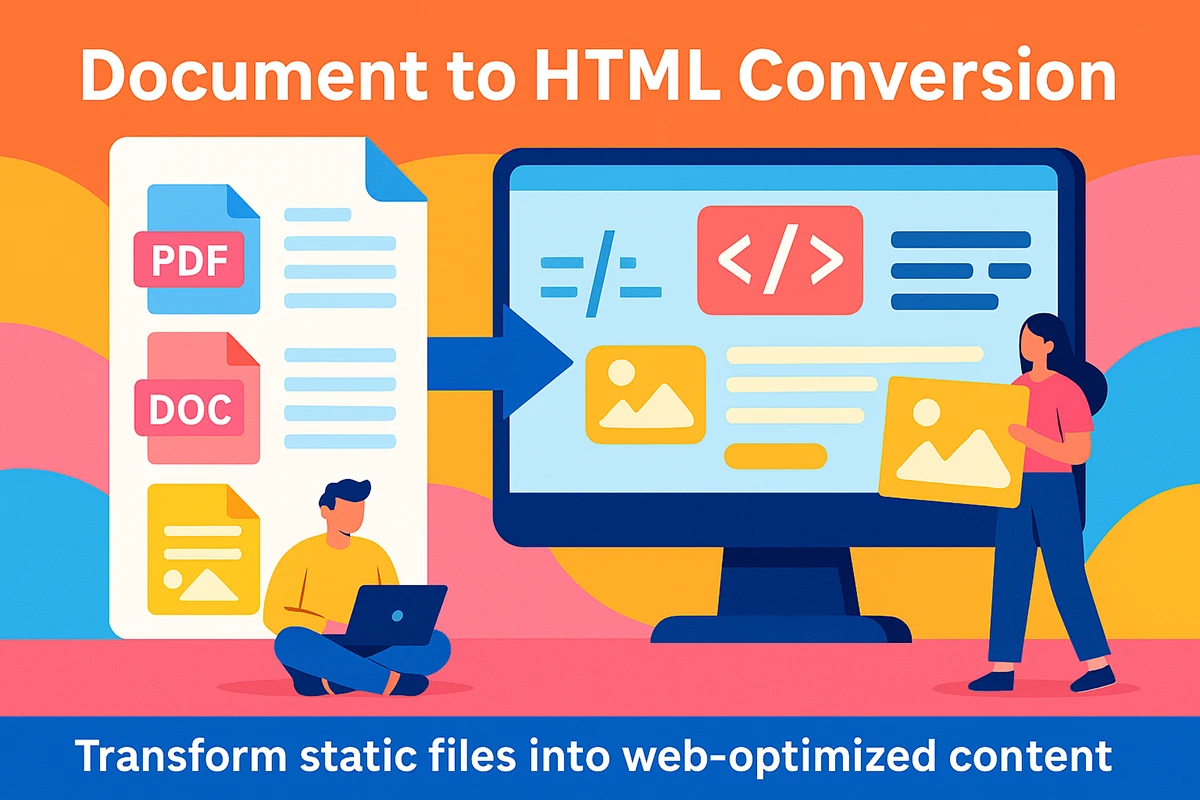
At Minnesota Design Studio, we help businesses transform outdated, static documents into clean, responsive HTML that’s built for the modern web. This image captures the power of that process, turning PDFs, Word files, and other locked formats into interactive, SEO-friendly content that looks great on any device. With vibrant colors and dynamic motion, it reflects the energy and flexibility that clean HTML brings to your digital strategy.
Why Document to HTML Conversion Matters
In today’s digital landscape, content needs to do far more than simply exist online. It needs to support discoverability, usability, accessibility, and long-term maintenance. Many organizations still rely on documents locked in static formats like PDFs, Word files, or spreadsheets to share important information. While these formats may appear polished and professional, they were never designed to function as core web content. As a result, they often fail to meet the expectations of modern users and search engines.
Static documents do not adapt well to mobile screens, which can lead to frustrating user experiences on phones and tablets. Text may appear too small, layouts may break, and users are forced to zoom, scroll horizontally, or download files just to access basic information. On top of that, search engines struggle to properly index and understand the contents of static documents, which means valuable information can remain hidden from search results. Accessibility is another major concern, as many document formats do not work reliably with screen readers or assistive technologies, creating barriers for users who rely on them.
HTML content, by contrast, is built specifically for the web. It adjusts naturally to different screen sizes, responds to touch and keyboard navigation, and works seamlessly across modern browsers and devices. Properly structured HTML can be read and understood by assistive technologies, making content more accessible to a wider audience. Search engines are also able to crawl, index, and rank HTML content more effectively, helping your information reach the people who are actively looking for it.
When documents are converted into clean, well-structured HTML, they become more interactive, more visible, and far easier to manage over time. Links can be added, navigation can be improved, and content can be updated directly within your website without re-exporting or redistributing files. What was once buried inside downloadable documents becomes a living part of your website, fully aligned with your overall digital strategy and branding.
Minnesota Design Studio offers professional Document to HTML Conversion services that focus on accuracy, performance, and consistency. We take rigid documents and rebuild them as fully structured HTML pages that reflect your brand, align with your site design, and function properly on every device. Whether you are converting a single document or an entire library of files, our goal is to help ensure your content works for you, supports your business objectives, and delivers a better experience for every user.
Built for Search, Mobile, and Accessibility
HTML content is designed for modern web use.
Properly structured HTML improves search visibility, works seamlessly across mobile devices, and supports assistive technologies so more users can access your content without friction.
HTML content is designed to work across devices and platforms.
Properly structured HTML improves search visibility, supports assistive technologies, and delivers a consistent experience on desktop, tablet, and mobile screens.
HTML content works harder than static documents.
Search engines can index HTML, screen readers can interpret it, and mobile users can interact with it comfortably. Converting documents to HTML removes barriers and turns your content into a usable, discoverable resource.
HTML content opens doors. It becomes interactive, searchable, accessible, and much easier to manage and update. If your organization relies on guides, catalogs, manuals, reports, or brochures, digitizing them into clean HTML helps future-proof your content while turning it into a meaningful asset for engagement, visibility, and brand consistency.
What Is Document to HTML Conversion?
Document to HTML Conversion is the process of turning traditional document formats such as PDFs, Microsoft Word files, Excel spreadsheets, PowerPoint decks, or even scanned physical documents into standards-compliant HTML. This is not a simple copy and paste process. It is a structured transformation that accounts for layout, hierarchy, branding, and ongoing usability.
Our team does not rely on automation alone. We combine proven tools with manual refinement to ensure the resulting HTML is responsive, well coded, and ready to integrate into your website or CMS. Whether you need simple text-based content or complex formatting with charts and branded layouts preserved, we ensure your documents retain their identity while gaining the flexibility of HTML.
Benefits of Clean HTML Conversion
When content is converted into HTML, it becomes significantly more useful. HTML loads faster than large document files, scales properly across devices, and supports interactive elements like links, embedded media, and internal navigation. This improves both user experience and search performance.
Another major benefit is accessibility. Properly structured HTML allows screen readers, keyboard navigation, and assistive technologies to interact with the content correctly. For organizations focused on inclusivity or compliance, HTML is a major upgrade over static file formats.
Types of Documents We Convert
At Minnesota Design Studio, we work with a wide range of document types. PDFs with complex layouts, Word and Google Docs, Excel spreadsheets, PowerPoint presentations, and even scanned documents can all be converted into responsive HTML.
Tables are rebuilt to remain readable on mobile. Presentations are translated into structured sections that retain visual hierarchy. Optical character recognition is used when needed to bring older or scanned materials back into a usable digital format. Each conversion is handled with care to preserve clarity while improving flexibility.
Preserve Design Without Being Locked In
Your content stays on brand and becomes easier to manage.
Converted HTML can mirror the look of your original documents while allowing updates, styling changes, and reuse without needing to re-export or re-upload files.
Optimized for Integration and Reuse
Once converted, your content can be used across nearly any modern platform. WordPress, HubSpot, Squarespace, Shopify, and custom CMS systems all support HTML content seamlessly. HTML content can also be reused across landing pages, email newsletters, internal portals, and resource libraries with minimal effort.
Ready to Convert Your Documents?
There is no reason to keep important materials locked inside static files that do not perform. Whether you are working with customer guides, regulatory documents, or internal training materials, Document to HTML Conversion helps that content work harder.
Reach out today to get a free quote and discover how your documents can be transformed into clean, responsive HTML built for the modern web.